Overview
Following recent shifts in energy policy, renewable energy sources, particularly solar energy, have seen significant prioritization and substantial capital investment. To ensure maximum return on investment and long-term operational efficiency, automated solutions are required to maintain peak performance across utility-scale solar farms.
Problem
Solar parks are continuously exposed to harsh environmental and weather conditions. Over time, this exposure leads to surface contamination (soiling, dust, bird droppings) and material degradation (hotspots, micro-cracks, cell failures).
These factors significantly impair the energy yield and overall profitability of photovoltaic (PV) assets. To mitigate these efficiency losses, regular inspection and maintenance are mandatory. However, manual inspections are labor-intensive, time-consuming, and costly.
Solution
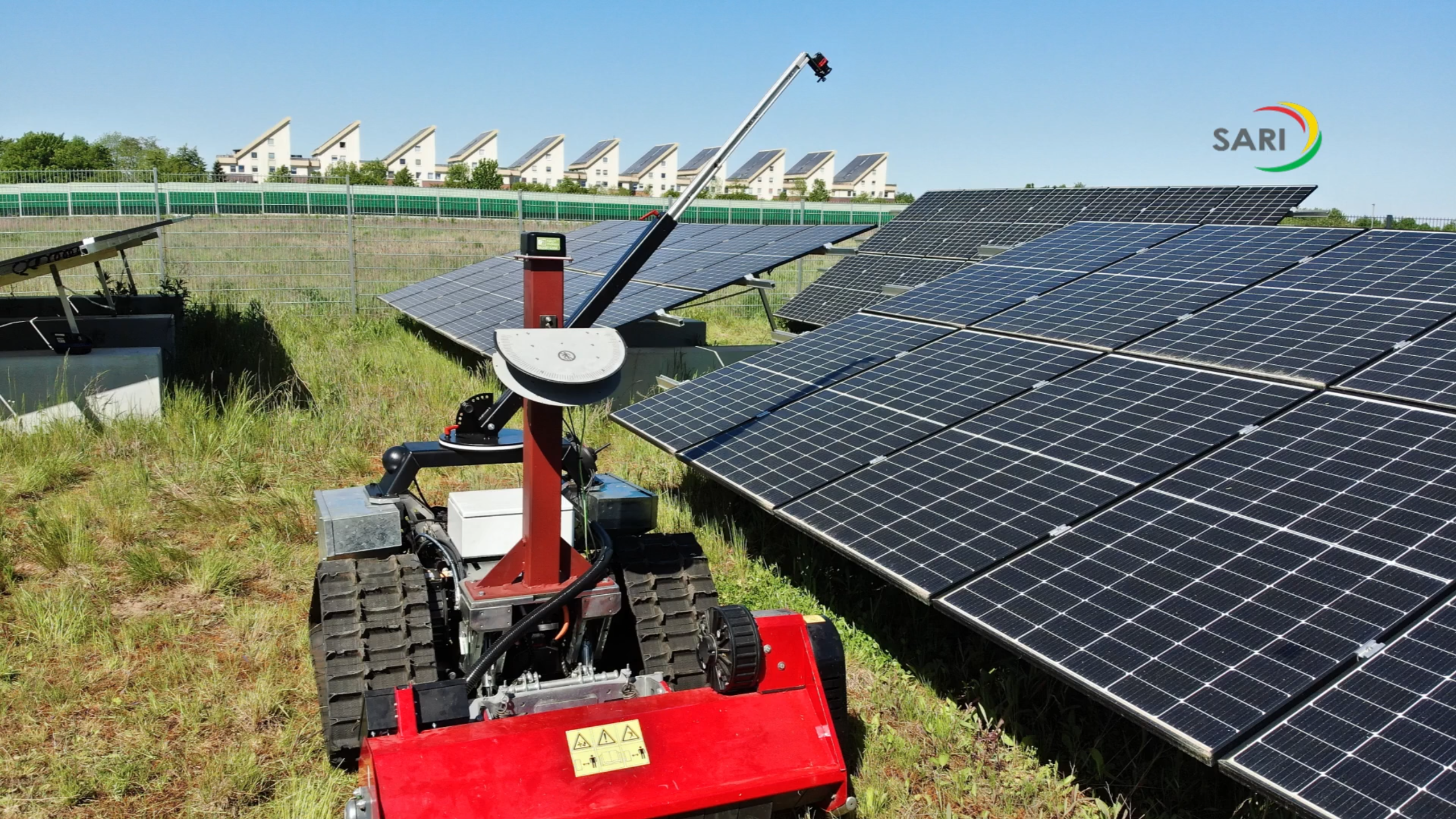
ERIS is a patented automatic fine positioning and inspection system for solar park applications.
The autonomous solution pairs a mobile base with a robotic arm to address key operational challenges through a decoupled hardware strategy:
Inspection Module
To asses Status, this module focuses on documenting and mapping panel degradation or defects using a robotic arm equipped with a dual-camera payload (Thermal + RGB).
Cleaning Module
Maintenance is achieved by removing surface contamination without panel damage by utilizing an arm-mounted motorized brush system.
Coarse Positioning
Mobile base uses LiDAR, GPS, and wheel odometry to align along panel rows.
Fine Positioning
The robotic arm precisely aligns the end-effector over target panels.
Business Value
Cost
Efficiency
Dramatically reduces manual labor costs and operational turnaround times.
Resource Optimization
Lowers water and material expenditure during cleaning operations.
Predictive Maintenance
Detailed georeferenced diagnostics enable proactive maintenance before catastrophic failures occur.
Asset Optimization
Sustains peak energy output and maximizes overall ROI for solar farm operators.
Implementation: Thermal Image Analysis
During my internship at Fraunhofer Institute IGP, I led the development of the AI-driven thermal image analysis system, designed to identify solar panel instances and accurately classify localized heat anomalies.
Concept
Thermal imaging allows non-intrusive identification of sub-surface cell failures, diode bypass faults, and localized thermal anomalies such as hotspots. To achieve this, a deep learning model is trained to detect and classify solar panels and the thermal anomalies within them. Detections are then later processed to generate a maintenance report.
[ Data Acquisition (Thermal) ]
             ↓
[ Image Preprocessing ]
             ↓
[ Thermal Anomaly Analytics ]
             ↓
[ Maintenance Report Generation ]
System Design Decisions
Why Standard Anomaly Detection Fails
Directly training an anomaly detection model on raw thermal images is unreliable. Because heat anomalies are extremely small and easily confused with random image noise, relying solely on a single AI model (like a CNN) leads to a high rate of false positives and false negatives.
Two-Stage Verification Pipeline To resolve this noise issue, the system uses a structured two-stage approach:
Stage 1: Instance Segmentation - A Convolutional Neural Network (CNN) detects individual solar panel instances and generates precise binary masks for each panel.
Stage 2: Target-Bound Anomaly Detection - Anomaly detection is performed strictly within the localized temperature matrices isolated by those binary masks, filtering out background noise.
Dynamic Thermal Thresholding
Within the segmented panel regions, heat anomalies are identified using a custom math formula that calculates a dynamic thermal threshold to reliably isolate genuine hotspots.
Reflection
Collecting a large dataset of thermal imagery in the winter season is tough! Even though I love the winter time, the lack of photons hitting the panels definitely made it a bit harder for me to progress.
The Impact I Made
Future Funding
After presenting my project achievements and showing a beyond successful Proof-of-Concept, I secured additional funding from stakeholders.
First point of Contact
With the return offer I also became the first point of contact for future computer vision and AI related tasks in one department at Fraunhofer IGP.
What I Learned
- The importance of cross-disciplinary collaboration in complex engineering projects
- The whole process of AI engineering, from raw data collection and preprocessing to model training, deployment, and performance evaluation.
- Speaking to stakeholders and presenting achievements in a clear and concise manner. That means contextualizing performance metrics - explaining that a model achieved X% accuracy across Y images collected under Z specific conditions, rather than just citing a isolated score and calling it a success.
- The ability to translate complex technical concepts for non-technical audiences while clearly outlining strategic next steps and model improvements.